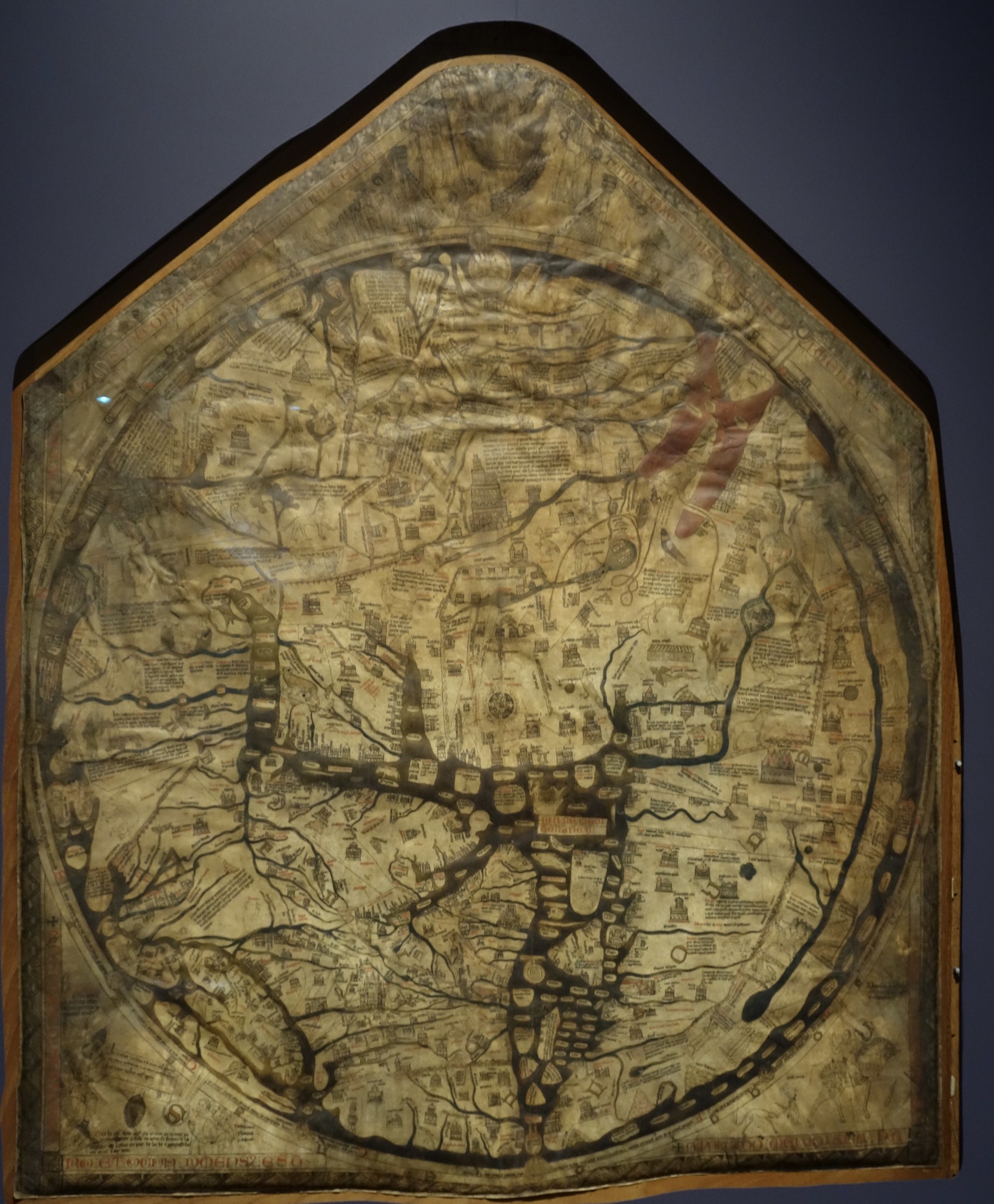
You would not use the Mappa Mundi to create a travel plan. Even in the Middle Ages, long before the plotting of latitude and longitude, there were navigational charts and land maps with some degree of accuracy.The Mappa Mundi, instead, represents an idea of the world and what it contains. Accordingly, the map portrays not only cities, rivers, and seas, but historical notes, legends, biblical stories, strange animals, and stranger humanoids.
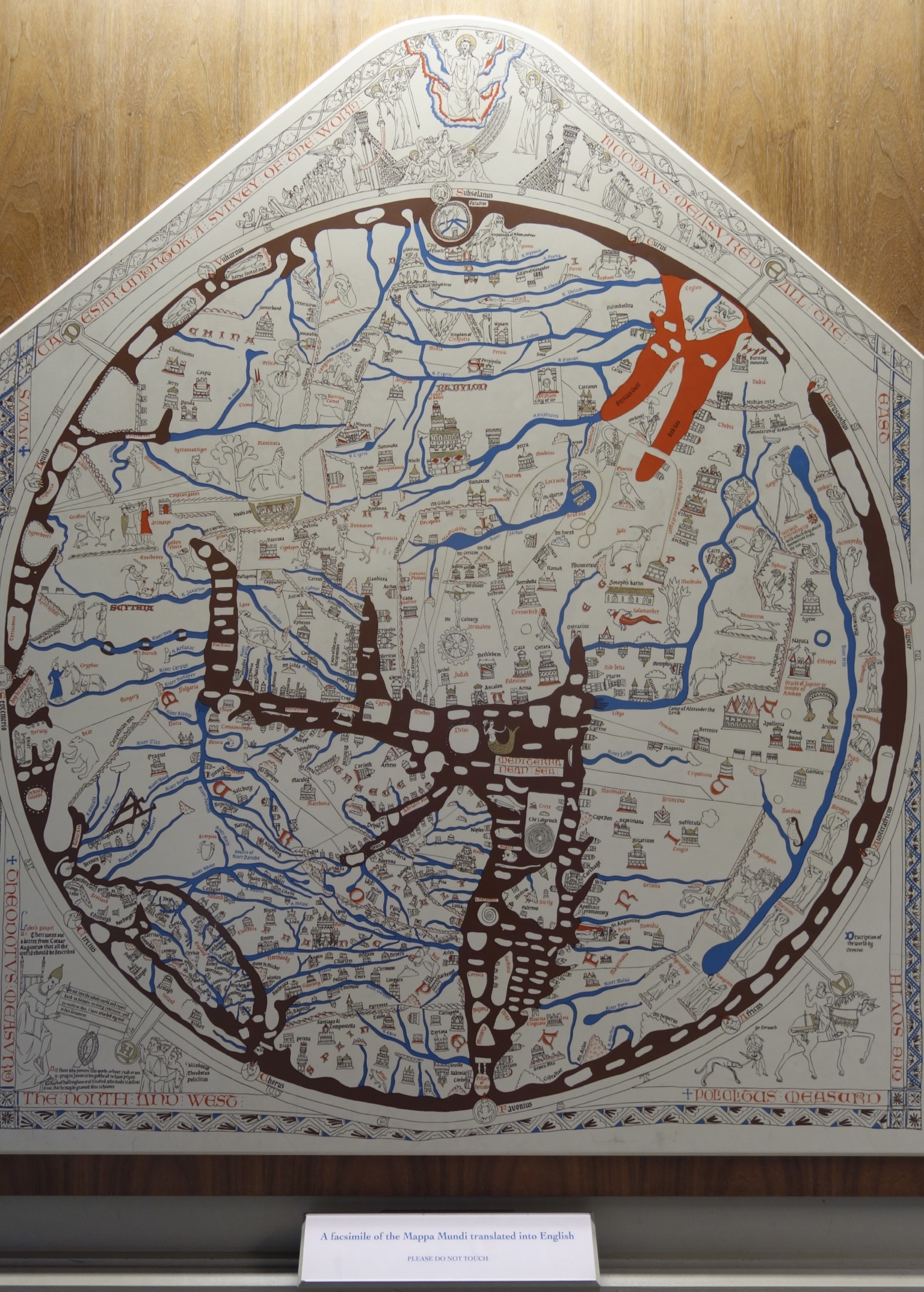
Mappa Mundi is a T and O map.The O is obvious, being the circular shape of the entire map surrounded by the sea. The T (more or less formed by the Mediterranean Sea) divides the map in three parts. Above the crossbar of the T is “Asia” – mostly what we refer to as the Middle East. To the left of the stem of the T is Europe (the British Isles are the lower left corner); to the right “Africa” – mostly the northern coast. Jerusalem is at the center of the world.
Below is a helpful facsimile with English translations. Enlarge the photo and explore the details.
Magna Carta
Hereford Cathedral also has a copy of the Magna Carta, the foundation document of English law.
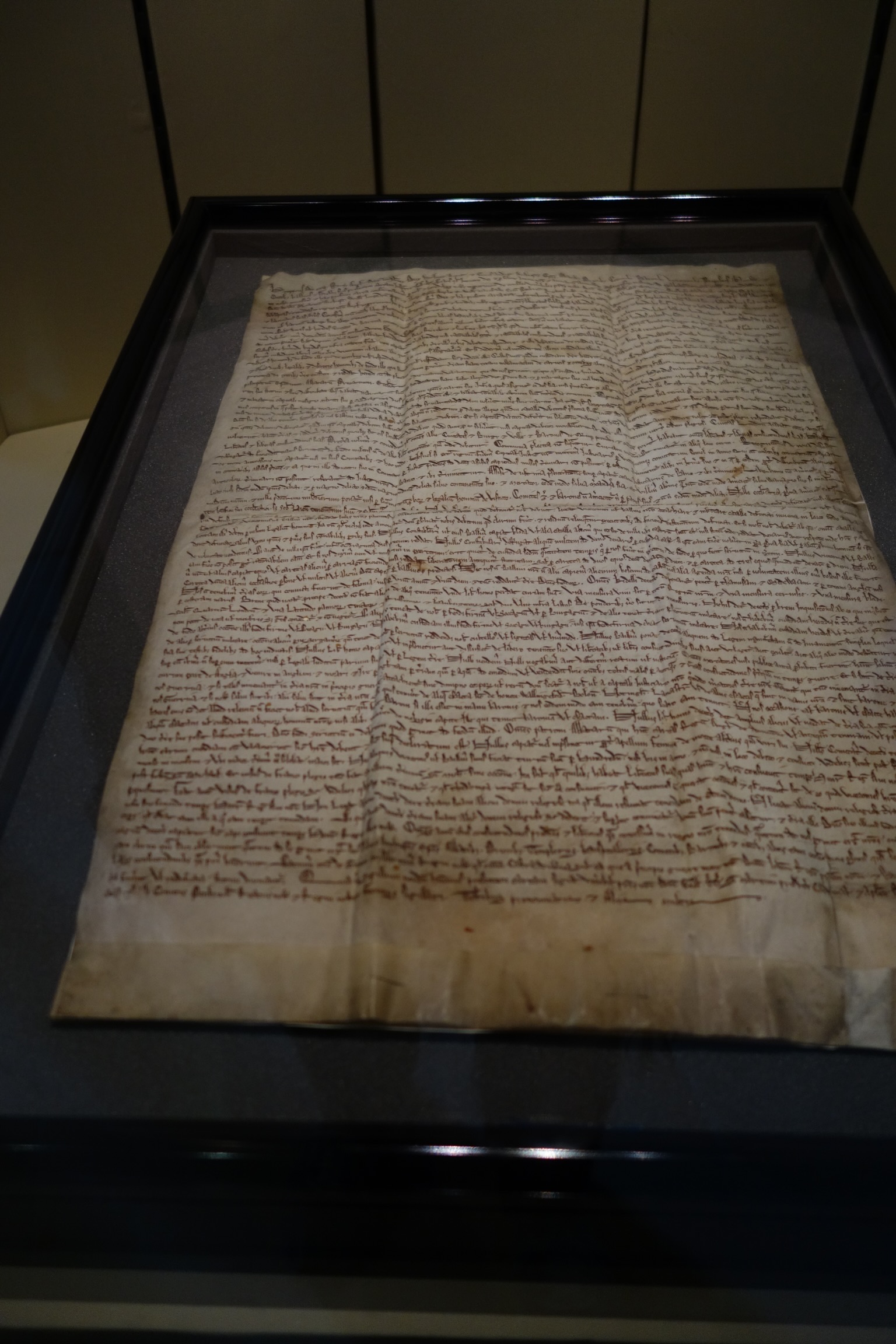
The Chained Library
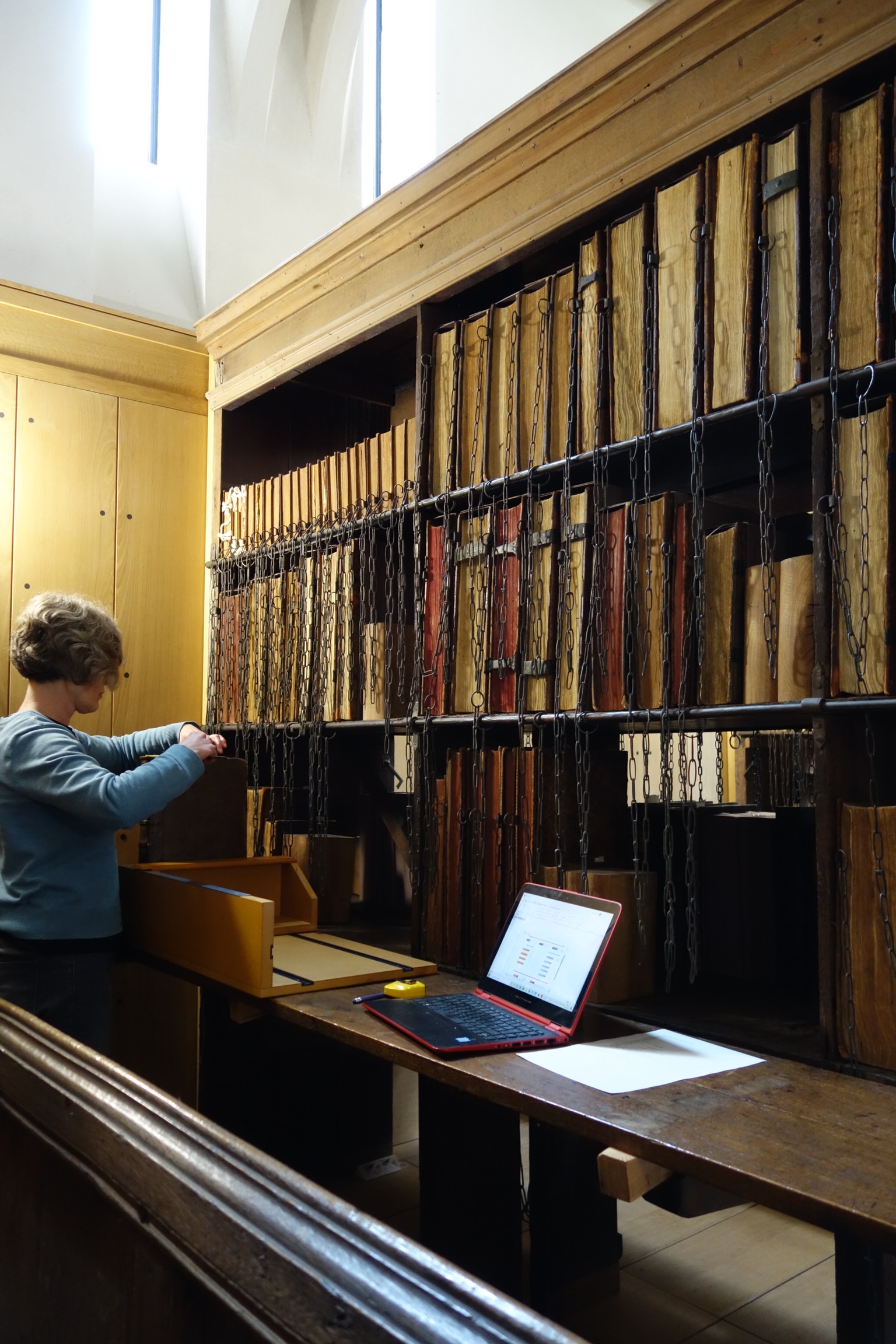
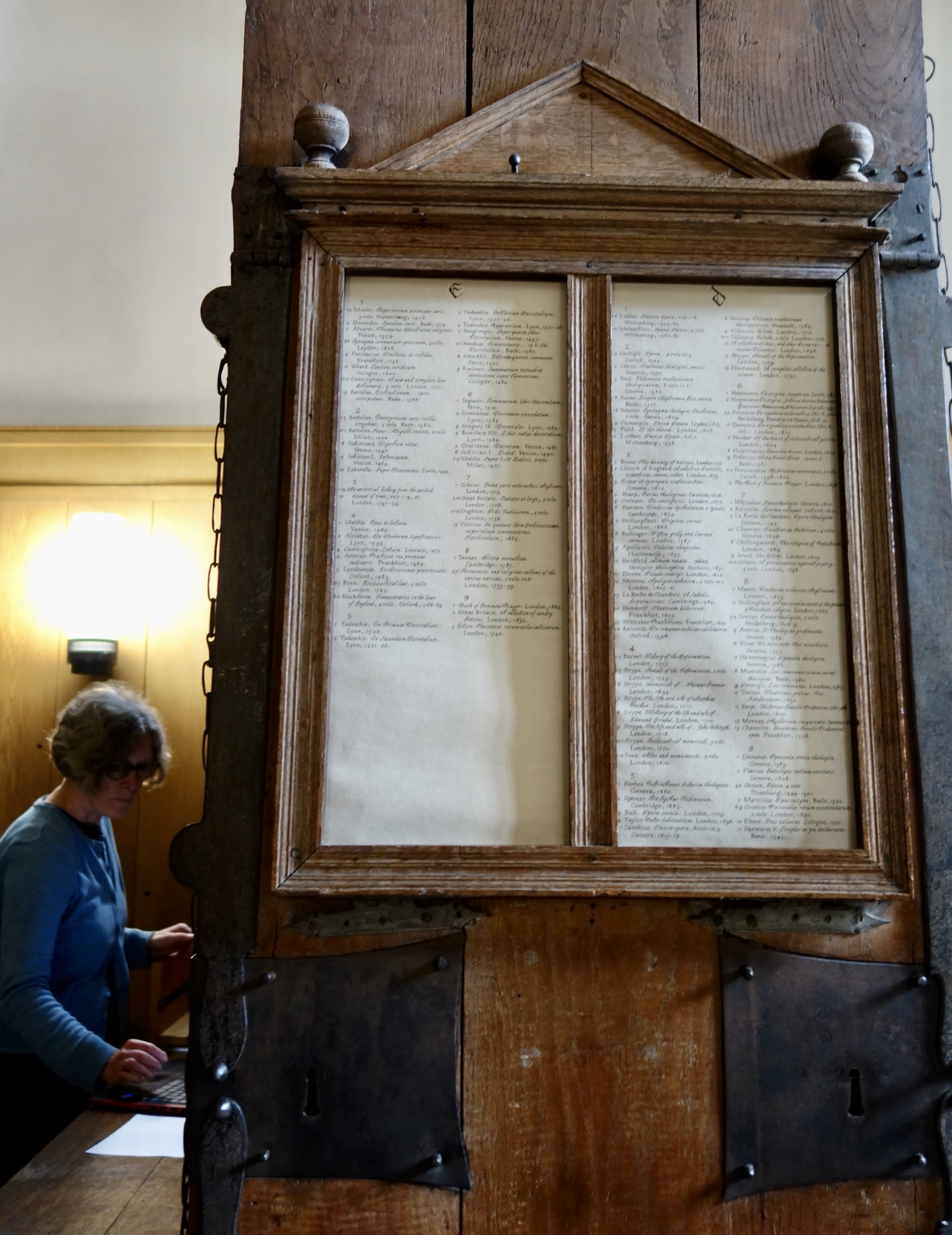
Hereford Cathedral also preserves the largest and most complete chained library in Europe. I asked the docent how it was that Hereford happened to preserve the largest, oldest, most complete library of its kind.
The docent replied that he had thought long and hard about the reason. He finally concluded that it was entirely due to the fact that between the time of Henry VIII and The Great War, absolutely nothing happened in Hereford.
By way of explaining chained book libraries, I quote from Hereford Cathedral’s site:
The chaining of books was the most widespread and effective security system in European libraries from the Middle Ages to the 18th century, and Hereford Cathedral’s 17th-century Chained Library is the largest to survive with all its chains, rods and locks intact.
A chain is attached at one end to the front cover of each book; the other end is slotted on to a rod running along the bottom of each shelf. The system allows a book to be taken from the shelf and read at the desk, but not to be removed from the bookcase.
The books are shelved with their foredges, rather than their spines, facing the reader (the wrong way round to us); this allows the book to be lifted down and opened without needing to be turned around – thus avoiding tangling the chain.